
Выборка по метке: "Современная проза". Страница 241

Viernes o Los limbos del Pac?fico
- Автор:
- Tournier Michel
- Язык книги:
- Испанский
- Кол-во страниц:
- 44
- Просмотров:
- 438
Dec?a Jorge Luis Borges que el significado de una novela como El Quijote no pod?a ser el mismo en el siglo XVII que en el XX. Pues bien, ?ste es el reto que ha afrontado el laureado escritor franc?s Michel Tournier al retomar la historia de Robins?n Crusoe y reescribirla desde una sensibilidad contempor?nea.
Toda la fe, la inocencia, el positivismo y el arrogante etnocentrismo del h?roe de Daniel Defoe, se convierten en la obra de Michel Tournier en duda sistem?tica, en conciencia de las invisibles relaciones entre Robins?n y la naturaleza que le limita y le otorga su identidad, y de los complejos, sutiles, conflictivos lazos que le unen a su alter ego, Viernes, un personaje que ha dejado de ser el sumiso esclavo del h?roe, para convertirse en el imposible interlocutor de un poeta.
Viernes o Los limbos del Pac?fico constituye un texto sugerente, en el que las peripecias de su solitario protagonista dan pie a la reflexi?n conjunta de autor y lector sobre el sentido de la condici?n humana y de la civilizaci?n. La novela se cierra con un final consecuente y paradigm?tico: Viernes viajar? en el velero que le conducir? a la sociedad occidental, Robins?n, que descubre justo entonces la atrocidad que se esconde en los valores jer?rquicos de la cultura a la que pertenece, rehusa subir a bordo y asume su condici?n de n?ufrago, en la inesperada compa??a de un grumete que huye, como antes el salvaje Viernes, de la cruel compa??a de sus compa?eros de raza y de cultura.

Русская дива
- Автор:
- Тополь Эдуард Владимирович
- Язык книги:
- Русский
- Кол-во страниц:
- 122
- Просмотров:
- 966
Эмигрант-плейбой, который любит Россию, должен любить и русских красавиц. Ценой эмиграции может быть не только отказ от русских женщин, не только инспирированный жестоким совковым бытием «любовный треугольник». Это — попытка избежать в череде невероятных приключений «ужасов советского режима». Это — интриги и убийства, секс и любовь и, главное, иронический финал, который не оставит равнодушным никого из читателей!
Запомним Таню мертвой
- Автор:
- Дивов Олег Игоревич
- Язык книги:
- Русский
- Кол-во страниц:
- 3
- Просмотров:
- 640
Гиперреалистический рассказ. Опубликован в декабре 2003 года в журнале "Знамя"
Neige
- Автор:
- Fermine Maxence
- Язык книги:
- Французский
- Кол-во страниц:
- 8
- Просмотров:
- 801
Au Japon, en 1884, Yuko Akita, ?g? de dix-sept ans, annonce la voie dans laquelle il a choisi de s'engager: il sera po?te, contre l'avis de son p?re, un pr?tre shinto?ste qui estime que la po?sie n'est pas un m?tier mais tout juste un passe-temps. Un po?te de la cour Meiji a n?anmoins vent des travaux de Yuko, lit ses po?mes, les trouve d'une limpidit? admirable mais lui conseille de trouver de nouvelles couleurs et pour se faire de rejoindre un homme qui poss?de les plus grandes connaissances artistiques, Sos?ki. Yuko part ? la recherche des couleurs de la neige, ?l?ment qui le fascine et ? partir duquel il compose tous ses ha?kus. En traversant les montagnes, il fait une d?couverte. Il tombe ?perdument amoureux du corps d'une jeune fille europ?enne, ? la beaut? diaphane, prisonni?re des glaces depuis longtemps. Sa rencontre avec Sos?ki, ancien samoura?, vieux peintre aujourd'hui aveugle, va le guider dans sa qu?te. Mais le savoir supr?me, Yuko ne le trouvera qu'aupr?s d'une femme, car seul l'amour peut faire na?tre l'absolu de l'art.
Au fil des dialogues entre le ma?tre et l'?l?ve, la fragilit? des choses, les images lumineuses du temps qui passe, la concision du langage ancrent ce r?cit initiatique dans la tradition et l'esth?tique des ha?kus dont il tire toute sa substance.
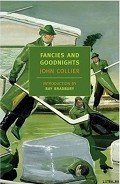
Fancies and Goodnights
- Автор:
- Collier John
- Язык книги:
- Английский
- Кол-во страниц:
- 112
- Просмотров:
- 1115
John Collier's edgy, sardonic tales are works of rare wit, curious insight, and scary implication. They stand out as one of the pinnacles in the critically neglected but perennially popular tradition of weird writing that includes E.T.A. Hoffmann and Charles Dickens as well as more recent masters like Jorge Luis Borges and Roald Dahl. With a cast of characters that ranges from man-eating flora to disgruntled devils and suburban salarymen (not that it's always easy to tell one from another), Collier's dazzling stories explore the implacable logic of lunacy, revealing a surreal landscape whose unstable surface is depth-charged with surprise.
Some of the stories in this book have been printed in The New Yorker, Harper's Bazaar, The Atlantic Monthly, Esquire, and Harper's Magazine; some of them have previously been gathered into a volume called Presenting Moonshine (published by the Viking Press, New York, 1941), and a volume called The Devil and All (published by the Nonesuch Press, London, 1934). Witch's Money was published as a separate volume, for private distribution, in December 1940. The Touch of Nutmeg, copyright, 1943, by The Readers Club. "Gavin O'Leary," copyright, 1945, by H. Allen Smith
Истории о призраках для мертвого
- Автор:
- Лиготти Томас
- Язык книги:
- Русский
- Кол-во страниц:
- 2
- Просмотров:
- 386
Gaspar, Melchor y Baltasar
- Автор:
- Tournier Michel
- Язык книги:
- Испанский
- Кол-во страниц:
- 44
- Просмотров:
- 558
El episodio de los reyes Magos s?lo mereci? unas l?neas por parte de uno de los cuatro Evangelios, pero ha impresionado vivamente la imaginaci?n d ela humanidad desde hace dos mil a?os. ?sta es una de las pocas novelas que existen sobre este assunto legendario. Uno de los reyes se supone que llega de la India, del reino de Mangalore.
High Rise
- Автор:
- Ballard James Graham
- Язык книги:
- Английский
- Кол-во страниц:
- 40
- Просмотров:
- 900
J.G. Ballard's 1975 novel "High Rise" contains all of the qualities we have come to expect from this author: alarming psychological insights, a study of the profoundly disturbing connections between technology and the human condition, and an intriguing plot masterfully executed. Ballard, who wrote the tremendously troubling "Crash," really knows how to dig deep into our troubling times in order to expose our tentative grasp of modernity. Some compare this book to William Golding's "Lord of the Flies," and there are definite characteristics the two novels share. I would argue, however, that "High Rise" is more eloquent and more relevant than Golding's book. Unfortunately, this Ballard novel is out of print. Try and locate a copy at your local library because the payoff is well worth the effort.
"High Rise" centers around four major characters: Dr. Robert Laing, an instructor at a local medical school, Richard Wilder, a television documentary producer, Anthony Royal, an architect, and the high rise building all three live in with 2,000 other people. Throughout the story, Ballard switches back and forth between these three people, recording their thoughts and actions as they live their lives in the new high-rise apartment building. Ballard made sure to pick three separate people living on different floors of the forty floor building: Laing lives on the twenty fifth floor, Wilder lives on the second floor, and Royal lives in a penthouse on the fortieth floor (befitting his status as the designer of the building). Where you live in this structure will soon take on an importance beyond life itself.
At the beginning of the story, most of the people living in the building get along quite well. There are the usual nitpicky problems one would expect when 2,000 people are jammed together, but overall people move freely from the top to the bottom floors. A person living on the bottom floors can easily go to the observation deck on the top of the building to enjoy the view, or shop at the two banks of stores on the tenth and thirty-fifth floors. Children swim and play in the pools and playgrounds throughout the high rise without any interference. Despite the fact that well to do people live in the building, with celebrities and executives on the top floors, middle-class people on the middle floors, and airline pilots and the like on the bottom ten floors, everyone gets along reasonably well-at first.
Then things change. The gossip level increases among the residents, and parties held on different floors start to exclude people from other areas. In quick succession, objects start to land on balconies, dropped by residents on higher levels. Equipment failures, such as electrical outages, lead to mild assaults between residents. Cars parked close to the building are vandalized, and a jeweler living on the fortieth floor does a swan dive out of the window. Every incident leads to further acts of violence and increasing chaos in the lives of those in the building. People begin to take a greater interest in what's going on where they live than in outside activities and jobs. As the violence escalates, elevators and lobbies on each floor turn into armed camps as the residents attempt to block any encroachments on their territory. What starts out as a book about living in a technological marvel quickly morphs into a study of how technology can cause human beings to regress back into primitivism. Moreover, Ballard tries to draw a correlation between the technology of the building and this descent into a Stone Age mentality. He shows in detail how the residents of the apartments sink back into the morass, passing through a classical Marxist structure of bourgeoisie-proletariat, moving on to a clan/tribal system, to a system of stark individuality. In short, Ballard tries to equate our striving towards individuality through technology with how we started out in our evolution as hunter-gatherers, as individuals seeking individual gains. The promise that technology will liberate the individual is not the highest form of evolution, argues Ballard, but is actually a return to the lowest forms of human expression.
Within a few pages of the story, I thought this might turn out to be very similar to a Bentley Little book. Little, nominally a horror writer but often a social satirist, often takes a situation like this and shows how people collapse under the pressures of modern life. My belief was not born out, however, not because Ballard doesn't take certain situations over the top but because he imbues his work with a significant philosophical subtext that Little would never write about. Bentley Little is all about focusing on the over the top, outrageous incidents of humanity's decline, whereas Ballard is more interested in serving as a preacher on anti-humanistic technology, thundering out a jeremiad concerning where we might go if we do not take the time to think very carefully about the society we wish to create.
"High Rise" is a dark, forbidding tale of woe that is sure to get a reaction from anyone who reads it. There seem to be few out there who can deliver such devastating blows to our love of technology as Ballard does in his works. This author is often referred to as a science fiction writer, but "High Rise" works just as well on a horror level. So does "Crash," when I think about it, although the cold, detached prose of that book is not present in "High Rise." Whatever genre Ballard falls into, this book delivers on every level.